Business · Analysis
IQVIA Q3 2026: Backlog Quality After the $2.1 Billion Reset
IQVIA's SEC filings show stronger bookings alongside a $2.1 billion backlog reduction. We analyze trial conversion, service revenue, cash timing and leverage.

IQVIA's third-quarter 2026 results combine stronger clinical bookings with a substantial cleanup of older backlog. The company removed $2.1 billion after reviewing inactive trials, while reporting continued growth in the business it is executing today.
The two developments can coexist. New awards can strengthen demand even as older projects become less likely to restart. The analytical task is to determine which parts of the contracted pipeline will turn into services, revenue and cash within a useful investment horizon.
Why did IQVIA reduce backlog?
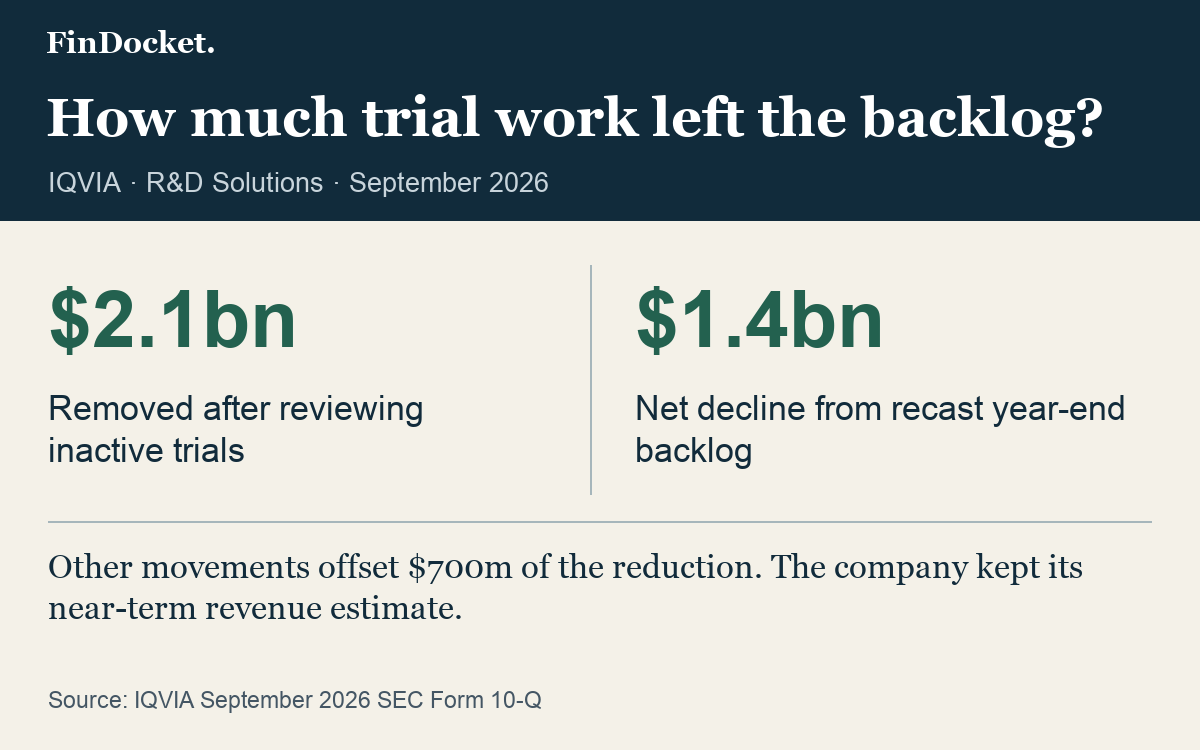
The Form 10-Q reports Research & Development Solutions backlog of $32.6 billion, versus a recast $34.0 billion at year-end. Refined criteria for expected activity on inactive trials reduced backlog by $2.1 billion. Approximately $9.4 billion is expected to convert into revenue over the next twelve months.
The reduction equals approximately 6.2% of the opening backlog. Without that specific adjustment, the ending balance would have been approximately $34.7 billion, or $0.7 billion above the opening figure. That is a simple bridge isolating the disclosed adjustment, not an alternative company-reported backlog number.
It shows why the aggregate decline alone is incomplete. The reported balance fell by $1.4 billion, but the removal of inactive work exceeded that decline. Other movements collectively offset part of the reduction.
At the same time, the adjustment is large enough to matter. A backlog figure includes expectations about work that can stretch years into the future. Removing inactive projects improves the usefulness of the estimate, but also demonstrates that nominally contracted demand does not guarantee execution.
The near-term conversion estimate matters more than the headline total
Management says the review does not affect historical financial results, 2026 guidance, book-to-bill or next-twelve-month backlog revenue estimates. This distinguishes an adjustment to anticipated future activity from a reversal of revenue already earned.
The $9.4 billion near-term conversion estimate represents approximately 29% of the remaining R&DS backlog. Most of the balance consequently lies beyond the next twelve months rather than constituting an immediate revenue stream.
That distribution is normal for long clinical programs, but it changes how backlog should be valued. A dollar of work expected next quarter has a different timing and execution profile from a dollar linked to a trial that has not resumed.
The strongest confirmation will come from actual conversion against the near-term estimate, alongside clear explanations for cancellations, scope changes and delays. The absolute contracted total is useful context; the timing and profitability of the work determine its economic contribution.
Stronger new bookings support the demand recovery
The earnings release reports $3.2 billion of quarterly net new bookings, up 15%, with a book-to-bill ratio of 1.2 times. Trailing-twelve-month net new bookings were $11.7 billion, up 14%.
A ratio above one indicates that new awards exceeded the associated period's revenue on management's measure. It supports future activity, but it does not specify when the work begins or how quickly sponsors authorize spending.
The distinction is especially relevant after an inactive-trial cleanup. Bookings describe new commercial commitments. Backlog describes the accumulated pipeline after revenue recognition and other changes. One cannot be substituted for the other, and a healthy new-award rate does not automatically make every older project active.
The useful combination is new awards, conversion of those awards into active trials and evidence that the work generates satisfactory margins. IQVIA has stronger evidence on the first measure; future filings need to confirm the subsequent stages.
Clinical revenue includes reimbursed expenses
R&DS quarterly revenue increased 8.7% as reported, or 9.1% at constant currency. Excluding reimbursed expenses, reported growth was 6.8%. Consolidated revenue reached $4.428 billion and adjusted EBITDA increased 8.7% to $1.032 billion.
The different clinical growth rates identify a mix consideration. Reimbursed spending is part of contract execution, but additional investigator or travel payments do not necessarily carry the same economic contribution as additional analytical and clinical service work.
Revenue growth should therefore be considered together with profit conversion. Faster growth in reimbursed items can raise revenue and associated costs while contributing less to incremental earnings. A recurring service business earns its return from the value retained after delivery costs, rather than the gross amount passing through customer contracts.
This does not make reimbursed revenue unimportant. It helps fund and execute trials. It simply requires a separate assessment of the fee-bearing work and the costs that accompany it.
Cash conversion also reflects contract timing
The filing shows unearned income increasing $195 million and unbilled services declining $42 million since year-end. The net balance consequently moved $237 million further toward unearned income. IQVIA links these balances to differences between revenue recognition and milestone invoicing.
Those movements show how a service provider can bill ahead of some recognized work while carrying other services that are not yet billed. A favorable aggregate position can support liquidity, but the company still owes the associated future services.
Quarterly operating cash flow was $825 million and free cash flow was $667 million, exceeding adjusted net income. Strong conversion supplies capital for financing and investment. It should be evaluated over multiple periods because customer milestones and project delivery do not occur on identical schedules.
The company reported net debt of $13.818 billion and a net leverage ratio of 3.45 times trailing adjusted EBITDA. With that financing structure, sustained cash conversion has practical value: it creates room to reduce obligations and fund growth without relying entirely on additional borrowing.
IQVIA's current results support improving demand and solid execution. The backlog reset makes the remaining pipeline more relevant, but it also reinforces why contracted totals need scrutiny. The decisive evidence will be active trial conversion, fee growth after reimbursed expenses and cash generation that persists as customer milestones and service obligations work through the accounts.