Economy · Analysis
The three numbers behind Iran’s oil revenue
An oil benchmark leaves out both the barrels sold and the price the exporter receives. Those figures are essential to estimating receipts.
A higher oil price is sometimes taken as evidence that an exporter has more money to spend. For Iran, that inference skips two quantities that are harder to observe than the benchmark on a trading screen. How much oil changed hands, and what price did the seller actually realize?
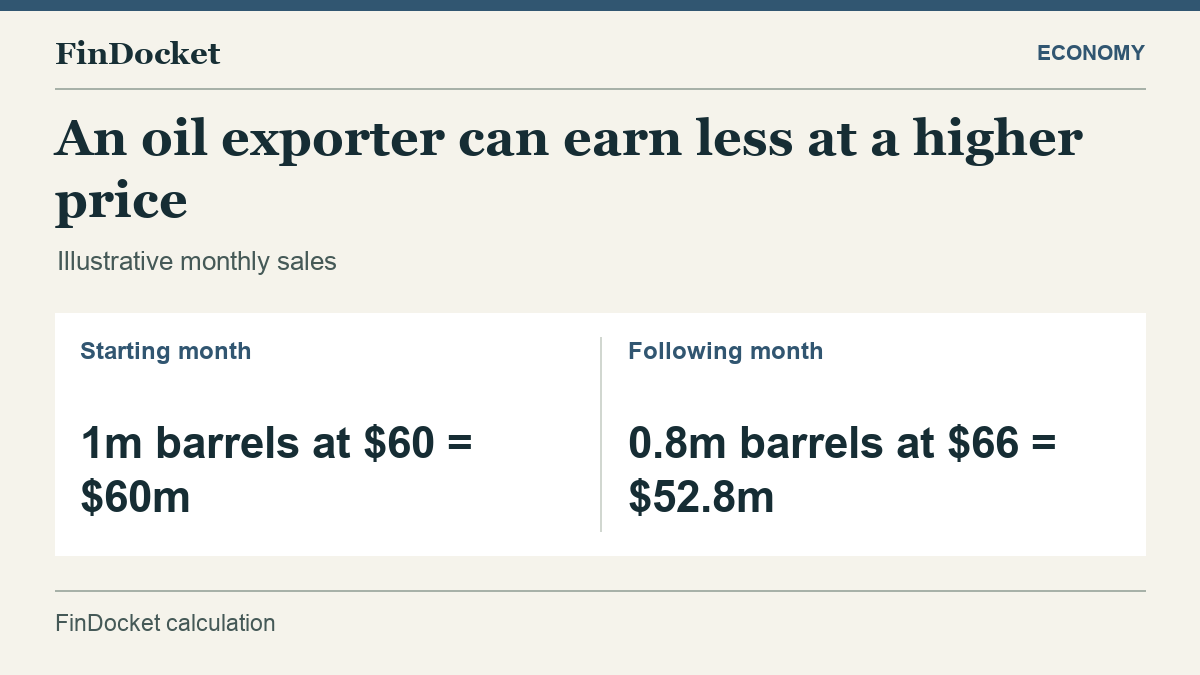
Consider a simplified month with one million barrels sold at $60 each. Receipts are $60 million. In the next month volume falls a fifth and the realized price rises a tenth to $66. Receipts fall to $52.8 million. A headline about higher prices and a headline about falling export income can both describe the same month. If the international benchmark rises while a seller's discount widens, the gap between the headlines can be larger still.
The US Energy Information Administration's country analysis provides historical context about Iran’s petroleum exports and the uncertainty around volumes and revenues. Reported production also needs care. Some domestic output goes to local refineries or storage, so it cannot all be multiplied by an international price and counted as export earnings.
To assess a claim about household hardship, one more bridge is necessary. Even a credible estimate of export revenue leaves open who received the money, when it became available to spend and how domestic prices changed. Price, volume and realized discount can establish part of the national income story. Consumer prices and purchasing power document the experience at home.