Economy · Analysis
What Japan’s ¥18.8 billion wildlife bill measures
A national crop-damage total gives the scale of the problem. Losses avoided per yen spent are the measure a district needs to choose a program.
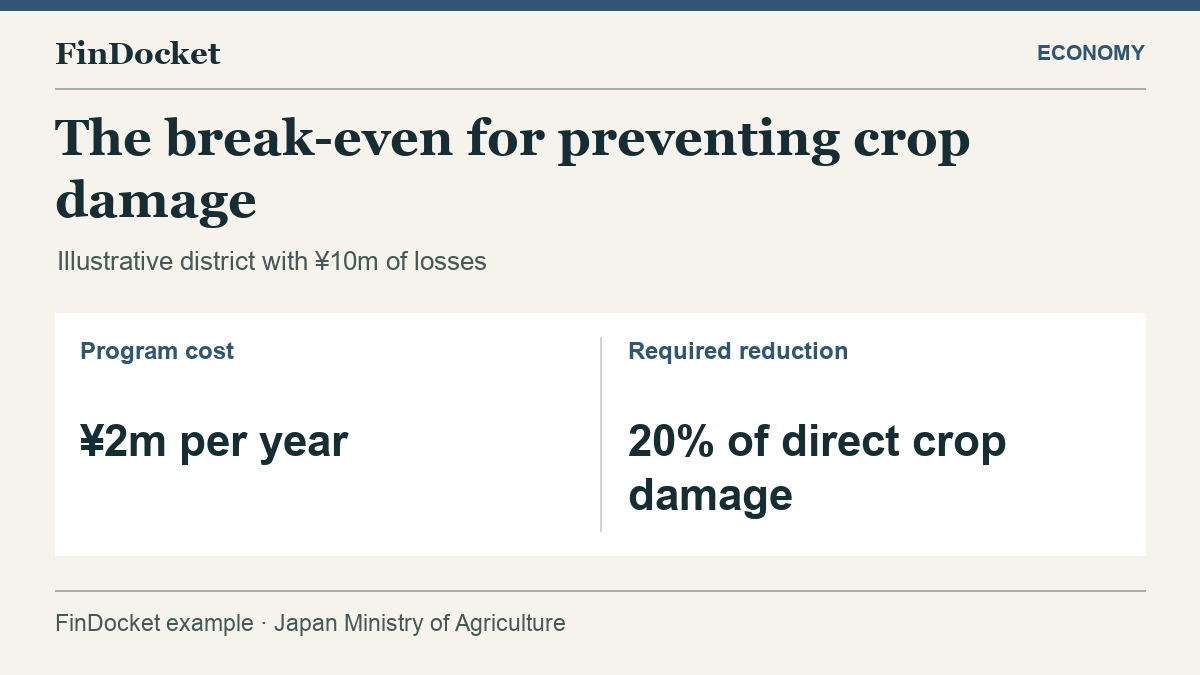
Japan's agriculture ministry puts reported crop damage from wild birds and animals at ¥18.8 billion in fiscal 2024. The total gives scale to the problem facing rural communities with fewer workers. It is also a difficult number to use in a village budget. A nationwide loss cannot tell a town what share of its own harvest it could save.
Consider a farming district reporting ¥10 million of direct losses. A proposed service costs ¥2 million a year. It must prevent one fifth of the reported damage to cover its cost on crop value alone. If it prevents only a tenth, the direct benefit is ¥1 million. If it prevents a third, the annual benefit is closer to ¥3.3 million. Travel time, staff availability, administrative costs and effects on neighboring farms can alter the decision.
MAFF's series offers a baseline for reported damage. It will miss some economic effects, such as a farmer deciding to leave a field unplanted after repeated losses. Conversely, simply treating all last year's losses as recoverable would overstate the benefit of any individual program. Weather changes and the mix of crops planted can also shift year-to-year totals.
The local comparison that matters is loss per cultivated hectare before and after a change, ideally alongside comparable untreated areas and the full cost of the program. That gives rural administrators a way to see whether scarce staff time is buying a measurable improvement.