Business · Analysis
The cost of reserving data center power in Ohio
A 50-megawatt contract illustrates the tiered minimum-demand formula behind the widely quoted 85% figure.
Power can constrain a computing project before a single server runs. A utility may need to invest in serving a large new site, while the site operator has an incentive to reserve more capacity than it initially uses. AEP Ohio's data center tariff puts an explicit price structure around that tension.
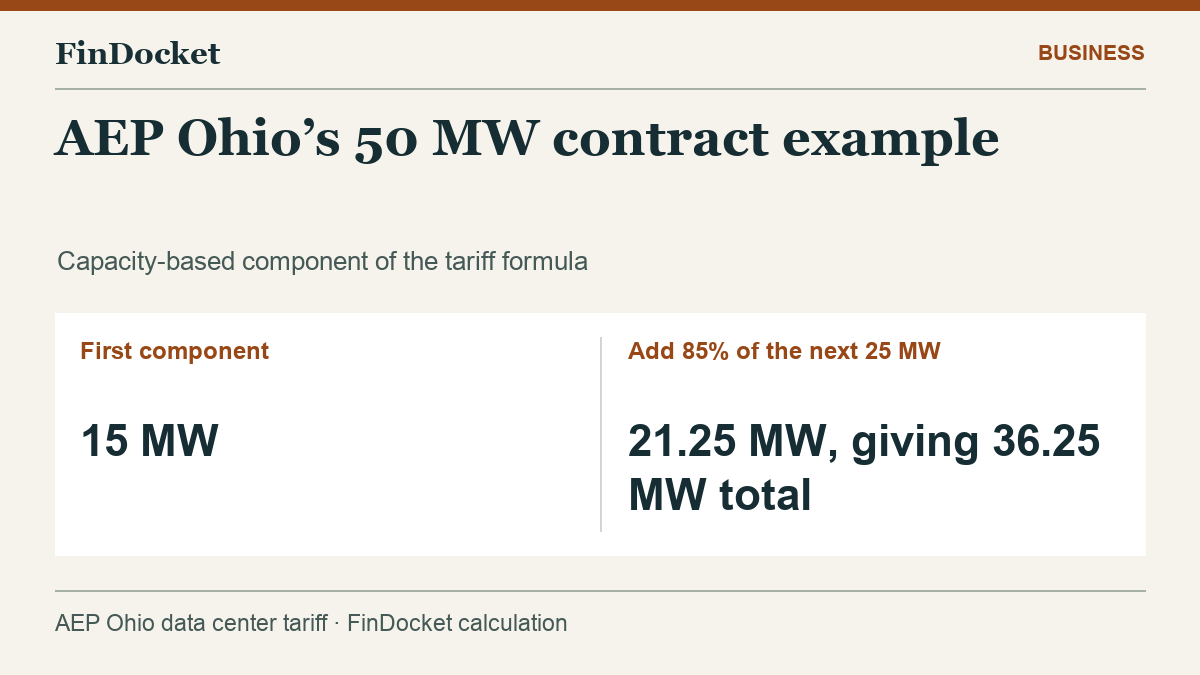
For customers in the specified 25,001 to 75,000 kilowatt contract-capacity range, the published capacity-based minimum uses 15,000 kilowatts plus 85% of capacity above 25,000 kilowatts. For a hypothetical 50-megawatt contract, the calculation is 15 plus 0.85 times 25, or 36.25 megawatts. That is 72.5% of the contract. Simply multiplying the whole 50 megawatts by 85% would give the wrong figure for this part of the formula.
The tariff also considers a percentage of the customer's highest previously established monthly billing demand, and other terms govern the total bill and ramp period. The example isolates one component. A megawatt of billing demand is also different from a megawatt-hour of electricity actually consumed. A customer can incur a capacity-related charge even when its servers draw less than their ultimate planned load.
For an investor comparing two proposed computing sites, access to a signed utility agreement is informative only alongside its minimums, milestones and cancellation obligations. Those terms determine who bears the cost if servers or customers arrive after the power infrastructure is ready.