Business · Analysis
Why NASA’s metal estimate for Psyche is not a mineral reserve
Scientific estimates of metal by volume leave several steps between the composition of an asteroid and the cash value of a reserve.
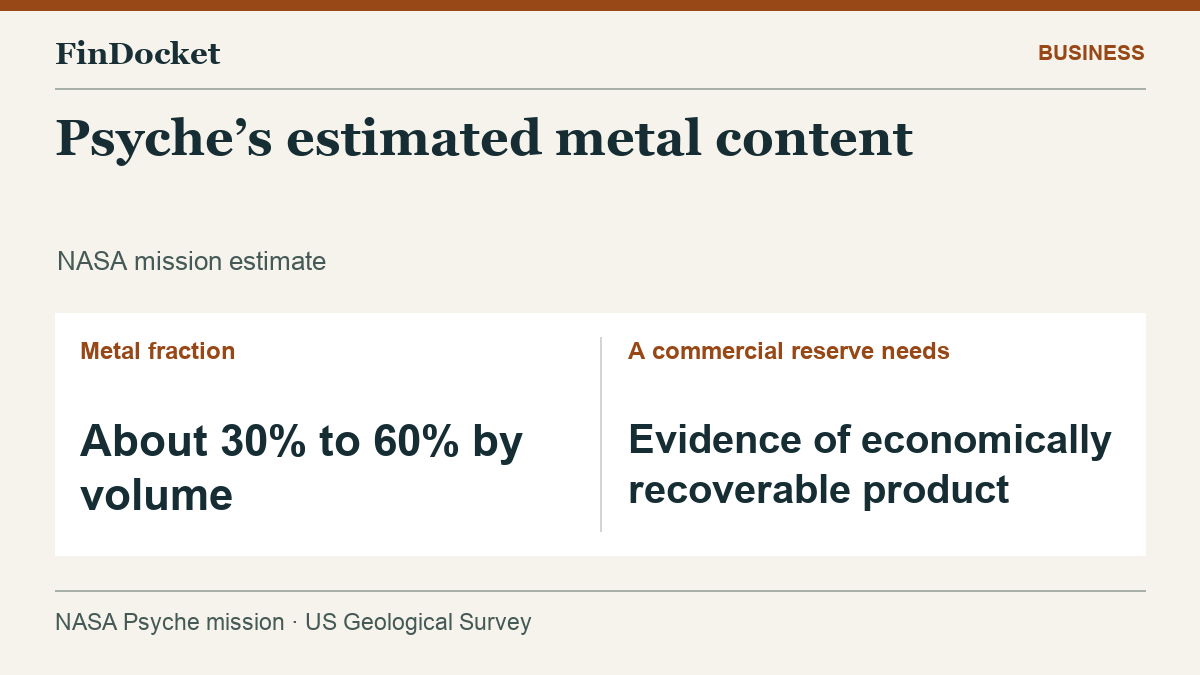
NASA describes Psyche as a metal-rich asteroid and estimates that metal could account for roughly 30% to 60% of its volume. The mission aims to investigate what the object is made of and how it formed. The wide range is already an important warning against putting a precise dollar value on its contents.
A percentage by volume cannot be multiplied directly by total mass to obtain tonnes of a saleable commodity. Different materials have different densities. A broad category of metal also does not identify the quantity of any specific marketable element. Even a much better composition estimate would leave open how much material could be recovered, processed and delivered, at what cost, over what period and to which market.
The US Geological Survey's reserve definitions bring economic feasibility into the classification. A mineral occurrence can be scientifically interesting with no demonstrated economic reserve. Multiplying a hypothetical quantity by an Earth spot price produces a gross in-place figure that omits capital, timing, recovery and selling costs. It also assumes the sales themselves would leave the market price unchanged.
The earliest commercially informative evidence from a mission like Psyche would be a narrower account of composition and structure, not a cash-flow projection. An economic comparison with a terrestrial deposit becomes possible only after both projects can be evaluated in units of recoverable product delivered to a defined buyer.