Business · Analysis
Who earns a dollar of trading fees on pump.fun?
A fee can be split among several recipients before incentives are paid. The denominator determines what a rewards percentage actually measures.
A post about pump.fun put $44 million of monthly revenue next to $11.8 million in callout rewards. Dividing the second number by the first produces 26.8%. Whether that ratio answers anything depends on the economic boundary of the numerator and denominator. Both figures are estimates cited by the poster.
Pump's official documentation describes fees allocated to different recipients, including creators, the protocol and liquidity providers, with schedules varying by market. A trader's gross fee is therefore not automatically the operator’s revenue. Likewise, a reward paid from a separate incentive budget might be an operating expense, an allocation of trading fees already counted or a transfer funded from an earlier period. Subtracting it twice understates the money retained.
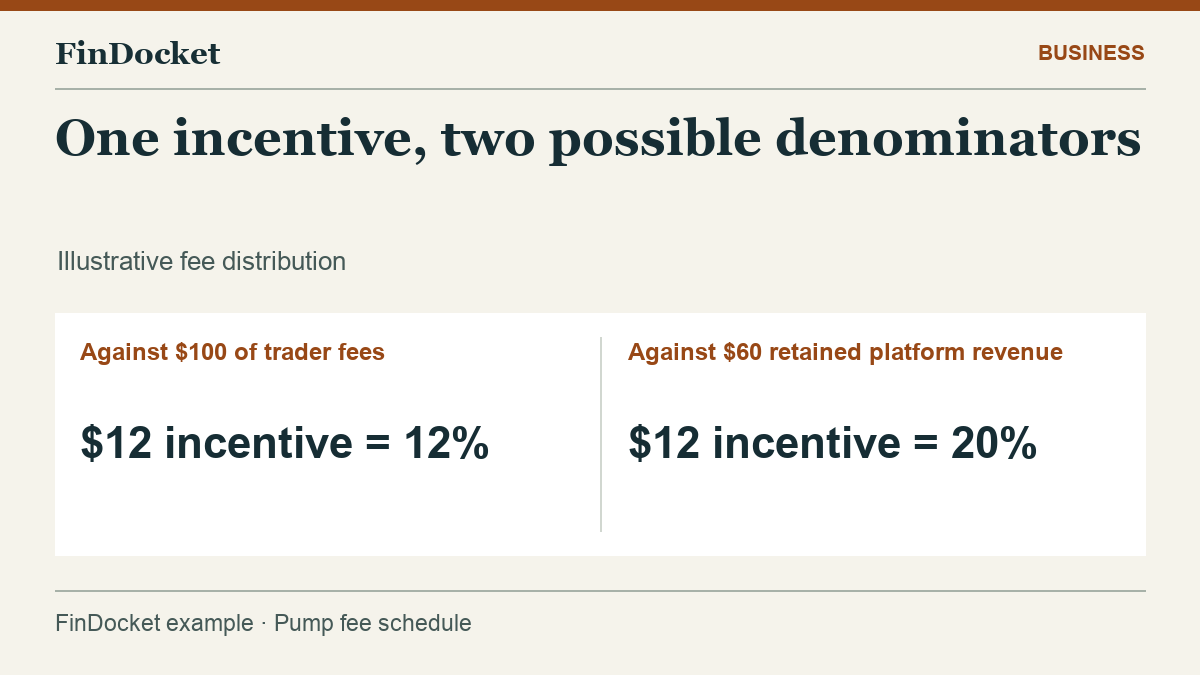
For an illustration, suppose traders pay $100. If creators receive $30 and liquidity providers get $10, the platform's share is $60. A $12 incentive funded from that share leaves $48 before other costs. The incentive is 12% of the original fee pool and 20% of platform revenue. Both percentages are correct answers to different questions.
A defensible estimate would list the wallets or accounts covered, the dates, gross fees, allocation to each recipient and the funding source for incentives. Trading volume and traders' investment returns belong in separate columns. That reconciliation can show who earned the fees. It still takes acquisition costs, operating expenses and other income to estimate profit.