Economy · Analysis
Why two $500 remittances can have different US tax bills
A cash transfer and a card-funded transfer of the same size can produce different tax bills. The statutory exception turns on the funding method.
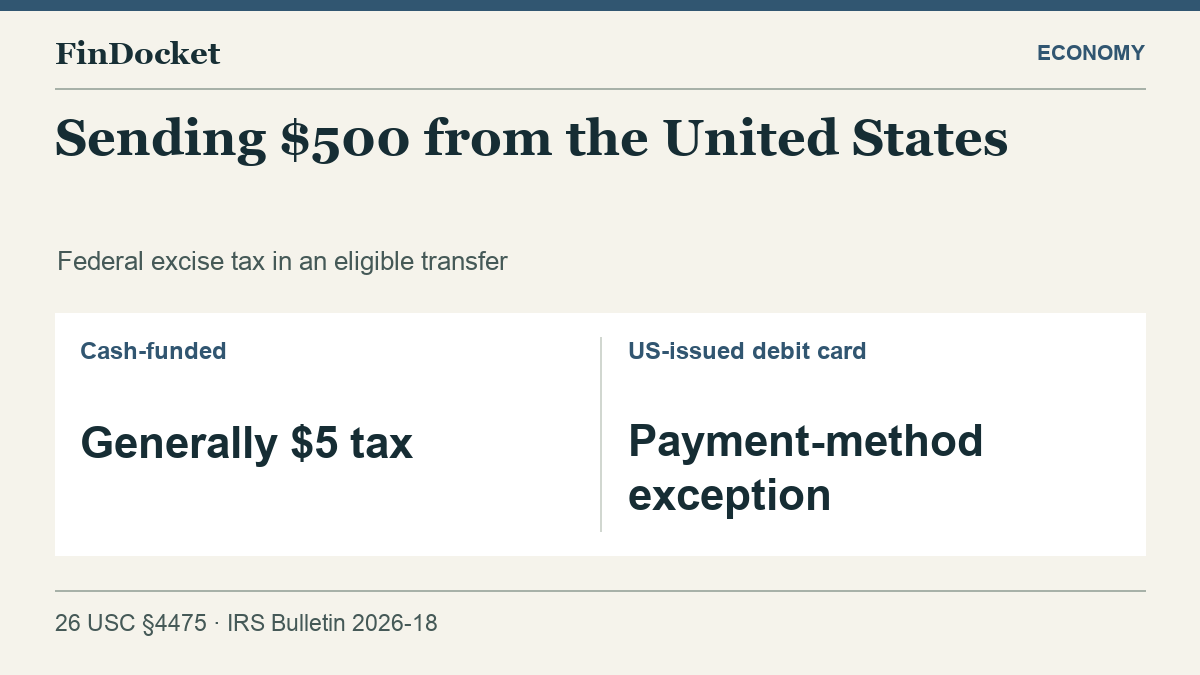
Take two customers sending $500 from the United States to relatives abroad. The first hands the provider cash. The second funds an otherwise identical qualifying transfer with a US-issued debit card. Under section 4475, the federal tax on the first transfer is $5. The second falls under a statutory exception. The amount and destination alone do not determine the result.
The law sets the rate at 1% of the amount transferred and places the obligation on the sender, with collection by the provider. It identifies cash, money orders and cashier’s checks among the payment methods that trigger the tax. It separately identifies qualifying account withdrawals and US-issued debit or credit cards for exclusion. Checking how the transfer is funded therefore reveals more about this particular tax than guessing who the sender is.
What difference does $5 make?
Suppose the provider quotes a $20 fee on a $500 cash transfer, without considering any exchange-rate difference. Adding $5 raises the explicit cost from $20 to $25. That is a 25% increase in this illustrative fee-plus-tax bill, even though the statutory rate is 1% of principal. A different fee changes the percentage increase.
The Treasury and IRS used the same distinction when analyzing the rule’s effect on typical remittances. A practical price comparison needs the funding method, the quoted fee, the exchange rate and the amount the recipient receives. A tax exemption on one payment method does not by itself establish which provider offers the lowest delivered cost.